You’ve seen the headlines. You’ve read the tweets. You’ve probably had at least one uncomfortable conversation at a networking event where someone casually dropped: “You know AI is going to replace designers, right?”
And you smiled. Nodded politely. Took a sip of your drink. And then went home and quietly Googled “will AI replace web designers” at 2 AM.
Don’t worry. We’ve all done it.
Here’s the thing – that headline up there? The one about 80% of web designers being replaced by 2030? It’s provocative on purpose. Because the real story is so much more nuanced than a scary number and a countdown clock. And nuance, unfortunately, doesn’t get clicks.
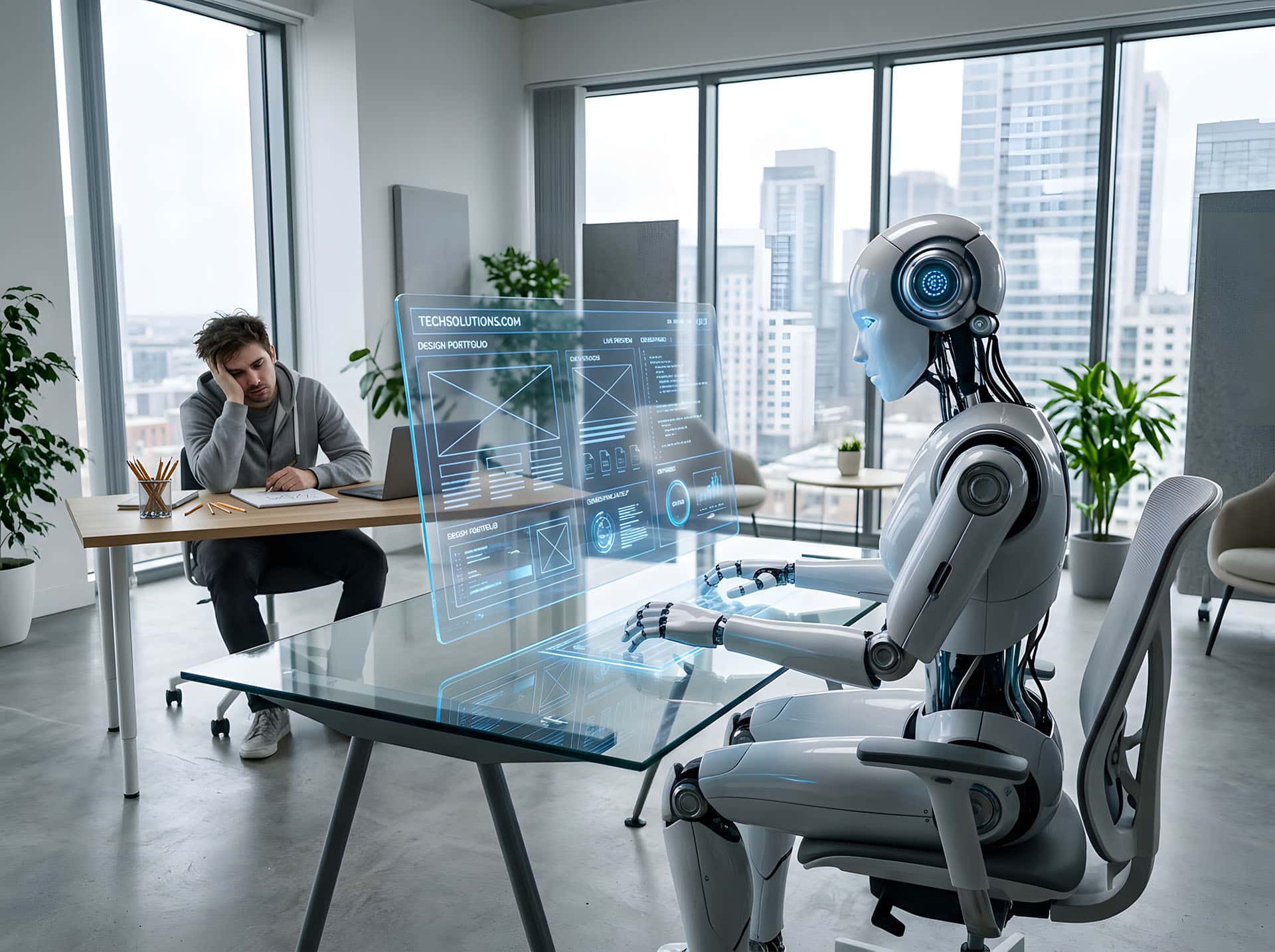
So let me give you the version that doesn’t fit in a headline: AI is absolutely, undeniably transforming web design. It’s eliminating certain types of work at a speed that should make you pay attention. And if you refuse to adapt, yes – you will get left behind.
But replaced? Entirely? By 2030?
Nah. Not if you’re reading this. Not if you’re the kind of designer who thinks critically about their craft and their career. Not if you’re willing to evolve.
Let me explain why I sleep just fine at night – and why you should too.
What AI Can Actually Do Right Now
Let’s not sugarcoat this. AI in 2026 is genuinely impressive.
Various AI tools generate visuals that would have taken designers hours to produce just three years ago. AI-powered website builders can spin up a fully functional, decent-looking site from a single text prompt. ChatGPT and Claude can write website copy that’s – let’s be honest – better than what half of our clients were giving us in their briefs anyway.
And it’s not just the creative side. AI can now analyze user behavior, suggest layout improvements, generate color palettes based on brand psychology, and even run A/B tests autonomously. The stuff that used to require a team of specialists can now be done by one person with the right prompts.
That’s real. That’s happening. And pretending it isn’t would be dishonest.
But here’s what I’ve noticed after spending serious time working with these tools every single day.
AI is incredibly good at producing average work – fast.
Need a generic landing page for a local business? AI nails it. Need a standard portfolio layout with placeholder copy? Done in minutes. Need a cookie-cutter e-commerce template that looks like every other cookie-cutter e-commerce template? AI’s got you covered.
But ask it to create something truly original – something that captures the specific personality of a nervous first-time business owner who makes handcrafted furniture in his garage and needs his website to feel warm but professional but not corporate but also trustworthy – and suddenly the magic starts to wobble.
AI can mimic patterns. It can remix what already exists. What it can’t do – not yet – is truly understand.
And that distinction matters more than most people realize.
What AI Still Can’t Do
Here’s a story for you.
Last month a client came to me with a brief that said – and I quote – “I want my website to feel like a warm handshake.”
Now. Go ahead and type that into any AI tool you want. I’ll wait.
What you’ll get back is something technically competent. Maybe some warm colors. A friendly font. A stock photo of two people shaking hands. And it’ll look… fine. Perfectly fine. Aggressively, forgettably fine.
But what that client actually meant – which I only understood after a 45-minute conversation over coffee – was that she’d spent 20 years in corporate banking, hated every second of it, and had finally started her own financial coaching business. She wanted her website to say “I understand money but I’m not one of those people anymore.” She wanted warmth without being casual. Authority without being cold. Approachability without being unprofessional.
That’s not a design brief. That’s a human story. And translating human stories into digital experiences is something AI fundamentally cannot do.
AI doesn’t understand context. It doesn’t know that your client’s competitor just launched a rebrand and they’re terrified of looking outdated. It doesn’t pick up on the hesitation in someone’s voice when they say “I trust your judgment” but clearly don’t. It doesn’t understand that sometimes the best design decision is the one that breaks every rule – because the situation calls for it.
AI doesn’t have empathy. It can simulate it. Impressively, even. But there’s a difference between generating the words “I understand your frustration” and actually understanding someone’s frustration. Clients don’t just need someone to build their website. They need someone to hear them. To make them feel like their business matters. To translate their anxiety into confidence.
AI doesn’t ask the right questions. It answers prompts. But the magic of great design has never been in the answers – it’s in knowing which questions to ask in the first place. Questions the client didn’t even know they needed to be asked.
That’s not a skill AI is coming for anytime soon. That’s a deeply human skill. And it’s worth more now than it’s ever been.
The Real Threat Isn’t AI – It’s Designers Who Ignore It
Let me tell you something that might sting a little.
The designers who will lose their careers by 2030 aren’t going to lose them to AI. They’re going to lose them to other designers who learned how to use AI.
There’s a massive difference between those two things.
Think about it this way. When Photoshop came along, it didn’t kill graphic designers. It killed graphic designers who refused to stop using paste-up boards. When WordPress democratized web publishing, it didn’t kill web developers. It killed the ones who insisted that every website needed to be hand-coded from scratch and charged accordingly.
The tool was never the threat. The refusal to pick it up was.
I wrote about this same pattern recently in the context of WordPress – designers holding onto a platform out of habit rather than strategy. The tool changes. The stubbornness doesn’t. Read the article here: WordPress Is Dying – And Most Web Designers Are Too Stubborn to Admit It
And right now – in 2026 – I’m watching the same pattern play out in real time. There are designers who’ve integrated AI into their workflow and are delivering better work, faster, at higher margins. And there are designers who’ve dug their heels in, arms crossed, insisting that “real design” can only be done the way they’ve always done it.
Guess which group is losing clients?
Here’s what the second group doesn’t understand. Clients don’t care about your process. They never did. They care about results – and speed – and value. When a competitor can deliver a comparable website in two weeks instead of six because they’re using AI to handle the repetitive stuff, your “handcrafted, artisanal, no-AI-touched” approach doesn’t sound principled. It sounds slow. And expensive.
That’s not me being harsh. That’s me being honest.
The good news? If you’re reading this article – if you’re the kind of person who seeks out conversations about where the industry is heading – you’re already ahead of most. The fact that you’re thinking about this puts you in a fundamentally different category than the designers who are pretending nothing is changing.
Now the question is – what are you going to do with that awareness?
The 80% That Will Be Replaced – And Why That’s Okay
Now let’s talk about that scary number. Eighty percent. It sounds terrifying when you attach it to “web designers being replaced.” But let me reframe it in a way that might actually make you feel better.
What if that 80% isn’t about people? What if it’s about tasks?
Think about your average workweek. Really think about it. How much of your time is spent on genuinely creative, strategic, meaningful work? And how much is spent on… the other stuff?
Resizing images. Setting up basic page layouts. Configuring contact forms. Writing alt tags. Building yet another hero section with a headline, a subheadline, and a call-to-action button. Adjusting padding and margins for the fourteenth time because the client wants it “just a little more breathable.”
Be honest. That stuff makes up a huge chunk of what we do. And it’s not the reason any of us got into design.
That’s the 80% AI is coming for. The mechanical. The repetitive. The work that requires skill but not necessarily thought. The tasks that feel productive but aren’t actually creative.
And here’s my slightly controversial take – good riddance.
I didn’t become a designer because I dreamed of spending my afternoons optimizing image compression and debugging CSS grid issues on Safari. I became a designer because I love solving problems. Understanding people. Translating ideas into experiences that make someone feel something.
If AI wants to handle the tedious 80% so I can focus on the meaningful 20%? That’s not a threat. That’s a promotion.
The designers who should be worried are the ones whose entire value proposition lives in that 80%. The ones who’ve built their careers on execution alone – on being fast hands rather than sharp minds. Because fast hands are exactly what AI replicates best.
But if your value lives in the 20% – in strategy, in empathy, in creative problem-solving, in the ability to make a client feel heard – then AI isn’t replacing you. It’s freeing you.
Why I’m Not Worried – And What I’m Doing Instead
So if AI is eating 80% of the tasks and reshaping the entire industry – why am I sleeping just fine at night?
Because I made a decision about two years ago that changed everything. I stopped competing with AI and started collaborating with it.
Every single day, AI handles things that used to eat hours of my time. First drafts of website copy. Layout explorations. Image generation for mood boards. Code snippets for tricky CSS problems. Content outlines for blog posts – yes, including this one. Things that used to be bottlenecks are now starting points.
And here’s what happened when I freed up all that time – I started doing more of the work that actually matters. More client conversations. More strategy sessions. More thinking about why before jumping into how. More of the 20% that AI can’t touch.
The result? Better work. Happier clients. Higher rates. Less burnout.
It’s not magic. It’s just math. When you eliminate the tedious stuff, you have more energy and bandwidth for the meaningful stuff. And the meaningful stuff is where the real value – and the real money – lives.
But here’s the part most people miss. This isn’t just about using AI tools. It’s about fundamentally rethinking what you offer. I’ve shifted my entire positioning from “I build websites” to “I help businesses create digital presences that actually work.” The website is part of that. But so is the strategy. The messaging. The user experience thinking. The ongoing guidance.
I’ve written in more detail about this shift – and the five specific steps I’m taking to future-proof my freelance business – in my deep dive on the state of WordPress in 2026.
AI made me a better designer – not because it does my job for me, but because it forced me to figure out which parts of my job were actually mine.
Turns out, the best parts always were.
The Bottom Line
So here we are. The end of the road – for this article, at least.
Let me keep this short and sweet. Because if you’ve read this far, you don’t need another lecture. You need a nudge.
AI is not coming for your career. It’s coming for your comfort zone.
The designers who thrive in 2030 won’t be the ones who outran AI. That’s impossible. They won’t be the ones who ignored it either. That’s career suicide. They’ll be the ones who learned to run with it. Who let it handle the mechanical work so they could focus on the meaningful work. Who understood that the most valuable thing a designer can offer was never pixels – it was perspective.
The 80% headline? It’s real – but only if you let it be. If your entire value as a designer lives in tasks that a machine can replicate, then yes – you should be worried. But if you’ve been reading this article and nodding along, if you’ve been thinking about how to evolve rather than how to hide – you’re already in a different category.
Here’s what I’d challenge you to do this week. Just this week:
Pick one AI tool you haven’t tried yet. Experiment with it. Break it. See what it can and can’t do.
Look at your last project and honestly identify which tasks could have been handled by AI – and which ones were uniquely, irreplaceably human.
Ask yourself – am I selling execution or am I selling thinking?
The future of web design isn’t human versus AI. It’s human with AI versus human without AI.
Choose your side wisely.
– The Subtle Creator