Let me tell you how most businesses end up hiring a web design agency.
They Google “web design” and find a slick website – ironically, the agency’s own – with photos of a trendy office, a team page full of smiling faces, and case studies that make everything look like it was touched by the hand of God. There’s a “Head of Strategy.” A “Creative Director.” A “Senior UX Lead.” An “Account Manager” who will be “your dedicated point of contact throughout the journey.”
Impressive, right? All those people. All that expertise. All working on your project.
Except – and here’s where it gets awkward – they’re not.
Here’s what actually happens behind the curtain. Your project gets assigned to a junior designer who graduated eight months ago. The creative director glances at it for approximately four minutes before the client presentation. The account manager – your “dedicated point of contact” – is simultaneously managing twelve other clients and can’t remember if you’re the bakery or the law firm. And that senior UX lead on the team page? They left the company six months ago but nobody updated the website.
You’re not paying for a team. You’re paying for the idea of a team.
Now look – I’m not saying every agency operates this way. Some are genuinely excellent. Some deliver incredible work with tight, talented teams who care deeply about every project. But those agencies are the exception, not the rule. And the gap between what most agencies sell and what most agencies deliver is wide enough to drive a truck through.
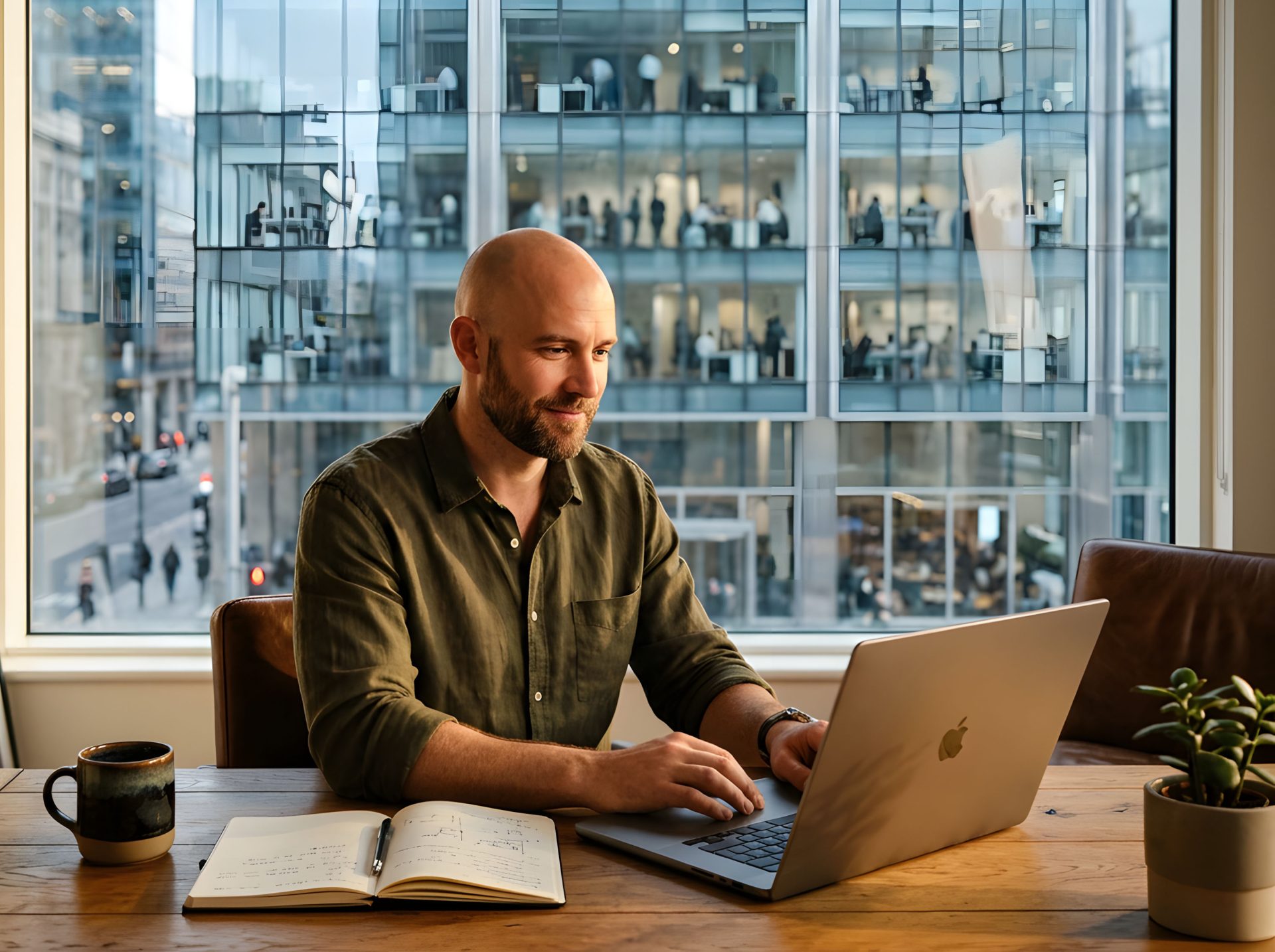
Meanwhile, somewhere in a home office – probably in sweatpants, definitely with coffee – there’s a solo freelancer who would have given your project more attention, more creativity, and more strategic thinking than that entire agency team combined.
For half the price.
Let me explain why.
The Solo Freelancer Advantage
Let me break down something that sounds counterintuitive but is painfully true once you see it.
One person who cares will almost always outperform a team that doesn’t.
Not because teams are bad. Teams can be incredible. But because the agency model has a structural problem that no amount of project management software can fix – layers.
Every layer between the client and the person doing the actual work is a layer where information gets lost, nuance gets flattened, and vision gets diluted. You tell the account manager your brand feels “adventurous but grounded.” The account manager writes in the brief “outdoorsy vibes.” The junior designer reads “outdoorsy vibes” and puts a mountain in the header.
That’s not a communication failure. That’s a communication structure failure. And it happens every single day in agencies around the world.
Now compare that to working with a solo freelancer.
Direct communication. You talk to the person doing the work. Not someone who talks to someone who talks to the person doing the work. When you explain that your brand feels “adventurous but grounded,” the person hearing those words is the same person translating them into design decisions. Nothing gets lost. Nothing gets flattened. The nuance survives.
Faster turnaround. There are no internal approval chains. No waiting for the creative director to review something between meetings. No scheduling a “sync” to discuss what was discussed in the last “sync.” A freelancer gets your feedback at 10 AM and you’re looking at revisions by lunch. Try getting that from an agency with a 47-step internal workflow.
Creative flexibility. Agencies have house styles – whether they admit it or not. When you’ve got a team of designers working across dozens of clients, consistency becomes more important than originality. Everything starts looking… samey. A solo freelancer doesn’t have a house style. They have your style. Because your project isn’t one of thirty on a whiteboard. It might be one of three. Maybe five. And that difference in attention changes everything.
Genuine accountability. This is the big one. When one person owns the entire project – from first conversation to final pixel – there’s nowhere to hide. No blaming the developer for misunderstanding the design. No blaming the account manager for miscommunicating the brief. No finger-pointing across departments. If something goes wrong, there’s one person responsible. And that person has every incentive to make sure nothing goes wrong.
I recently wrote about how the web design landscape is shifting – and why the tools and relationships we choose matter more than ever.
There’s something else that doesn’t get talked about enough. When you hire a freelancer, you’re hiring the person whose work you actually saw. That portfolio you loved? They made it. Every pixel. When you hire an agency, you’re hiring a brand. The person whose work impressed you might not even work there anymore. And even if they do – there’s no guarantee they’ll be anywhere near your project.
You’re not buying talent. You’re buying a logo and hoping the talent comes with it.
When an Agency Actually Makes Sense (Being Fair)
Alright. I’ve spent two sections throwing punches at agencies. Time to be honest and give credit where it’s due.
Because here’s the thing – I’m not delusional. There are situations where a solo freelancer simply isn’t the right call. And pretending otherwise would make me exactly the kind of biased, ego-driven designer I’ve been warning you about.
Large-scale, multi-disciplinary projects. If you’re building an enterprise platform that requires a team of developers, a UX researcher, a copywriter, a motion designer, a backend engineer, and a project manager all working in parallel – you need an agency. Or at least a very well-coordinated team. One person cannot be fifteen people, no matter how much coffee they drink. Trust me. I’ve tried.
Ongoing, high-volume work. If your business needs constant output – weekly landing pages, daily social media assets, monthly campaign launches – a single freelancer will eventually hit a bandwidth ceiling. Agencies have the infrastructure to absorb volume. That’s a genuine advantage.
Specialized technical builds. Complex app development. Custom SaaS platforms. Large-scale e-commerce with thousands of SKUs and intricate inventory systems. These projects often require deep specialization across multiple disciplines simultaneously. A freelancer can coordinate with other specialists – and many do – but sometimes the project genuinely demands an integrated team under one roof.
But here’s the key distinction.
Those scenarios represent maybe 10-15% of the projects that agencies actually take on. The rest? Small business websites. Brand refreshes. Landing pages. Portfolio sites. Basic e-commerce stores. Projects that a skilled solo freelancer could handle with one hand while sipping an espresso with the other.
And yet – businesses keep hiring agencies for these projects. Not because they need an agency. But because they think they need an agency. Because the agency’s marketing convinced them that bigger means better and more people means more quality.
For most small-to-medium businesses, hiring an agency for a standard website is like hiring a construction crew to hang a picture frame. They’ll get it done. Eventually. After three meetings, a revised scope, and an invoice that makes your eyes water.
The Bottom Line: You’re Not Paying for a Team – You’re Paying for Attention
Let me tell you what the most valuable thing in web design is in 2026.
It’s not a bigger team. It’s not a fancier office. It’s not a project management tool with seventeen integrations and a Gantt chart that looks like a subway map.
It’s attention.
Real, focused, undivided, I-remember-what-you-said-three-weeks-ago attention. The kind where your designer notices that your brand voice shifted mid-brief – not because they ran an AI analysis, but because they’ve been listening. Actually listening. The kind where they remember your dog’s name, know your biggest competitor just launched a rebrand, and understand why that one shade of blue makes you uncomfortable because it reminds you of your old corporate job.
That’s not something you get from an agency. That’s something you get from a person.
Agencies sell scale. They sell the comfort of a big team, a structured process, and a fancy proposal with timelines and deliverables and words like “synergy” that nobody actually understands. And for certain projects – as we’ve discussed – that scale is genuinely necessary.
But for most businesses? Most real, human, trying-to-make-it-work businesses? What they actually need isn’t scale. It’s care. It’s someone who treats their project like it matters – because to them, it does. It’s their livelihood. Their dream. Their thing.
And here’s the beautiful irony of it all. The solo freelancer – the one person in sweatpants with a coffee and a laptop – is often better positioned to deliver that care than an entire agency. Not because they’re more talented. Not because they work harder. But because their model allows for something that the agency model structurally cannot provide: a genuine human relationship between the person who needs the work and the person doing the work.
No layers. No filters. No game of telephone. Just two people figuring it out together.
That’s what I offer at The Subtle Creator. Not a team. Not a process. Not a deck full of buzzwords. Just attention, experience, and a genuine investment in making your project the best it can be.
Sometimes that’s all you need.
Actually – most of the time – that’s exactly all you need.
– The Subtle Creator